Creating A Print
Oct 21, 2025
Hello Friends,
Over the years of learning to make reduction prints I have written about the process for publications, for galleries and to address questions from you. I thought I would rework some of my writing so that you might better understand what I do.
Let me start at the beginning. My ideas come from a variety of inspirations and sources. Sometimes the initial impetus is nothing more than a glimpse of the landscape while driving down the road. Everyone has the experience of seeing something beautiful while driving along. Such a striking image in my mind is usually far better than any photograph I might have taken - which I couldn't because I'm driving! But the idea of it stays with me, sometimes for years before I attempt to translate it into a print.
In all cases my ideas start with a mood; quiet, bright, mysterious, sultry. What do I want the image to feel like? In my prints, color is what defines and imparts mood. My practice using color comes from four decades+ painting in watercolors and oils. My compositions come from photographs I've taken, drawings (always black and white) and hybrid images composed on the computer. I'm not trying to compose what a print will look like as much as creating instructions to myself for how I will carve the block.
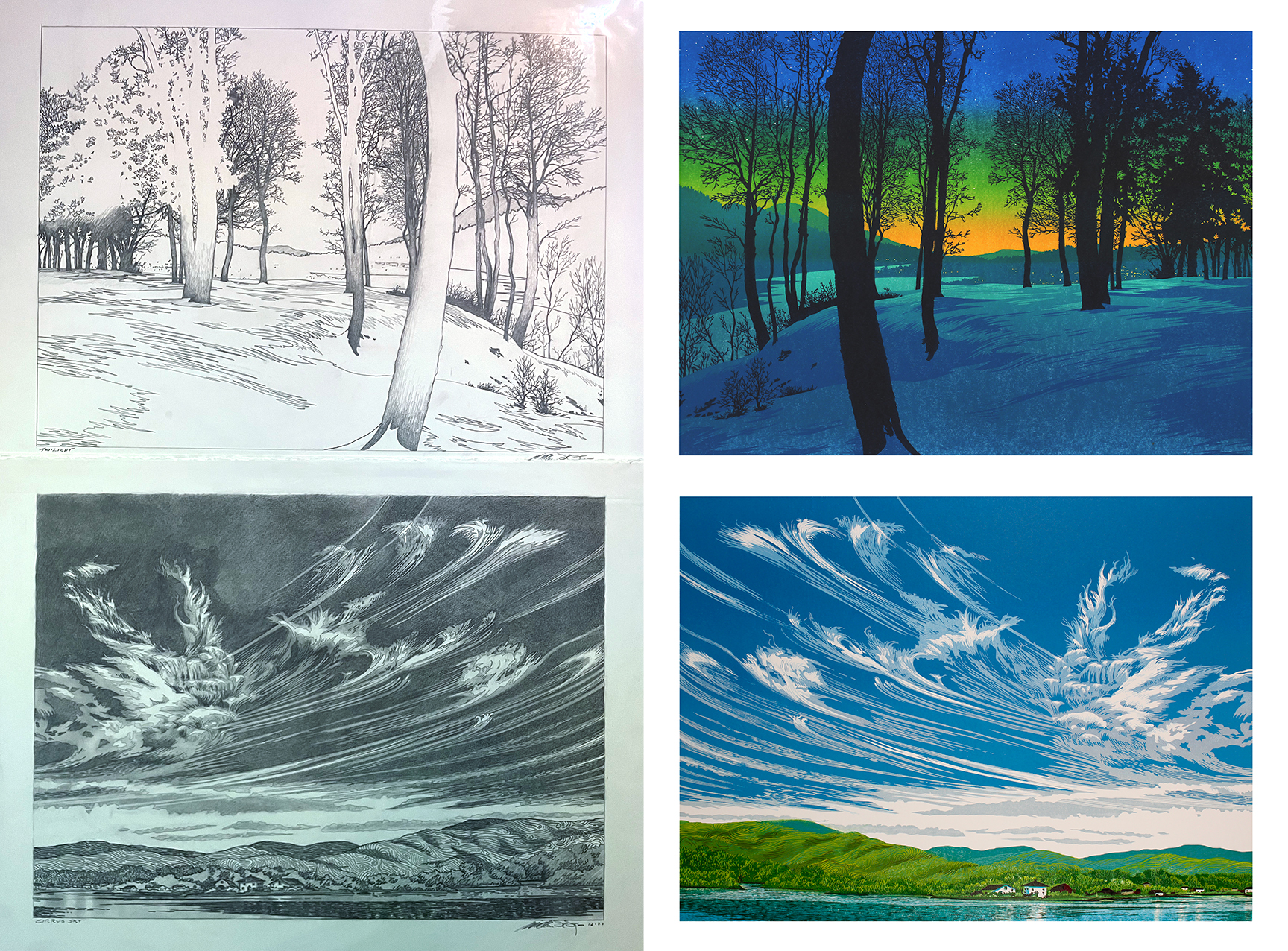
Two preparatory drawings and the resulting prints for "Twilight" and "Cirrus Sky", both woodcuts, 18.5" x 25" (47.5 x 64)
My landscape prints are inspired by two primary motivations. One, they are an homage to the extraordinary beauty that exists within the ordinary, everywhere, all the time. I look for poetry in the prose of our everyday existence. Secondly, the prints are a statement about my understanding of the pervading presence of a Creator's hand. I address this most directly through my compositions, using rhythms and patterns to create balance and harmony.
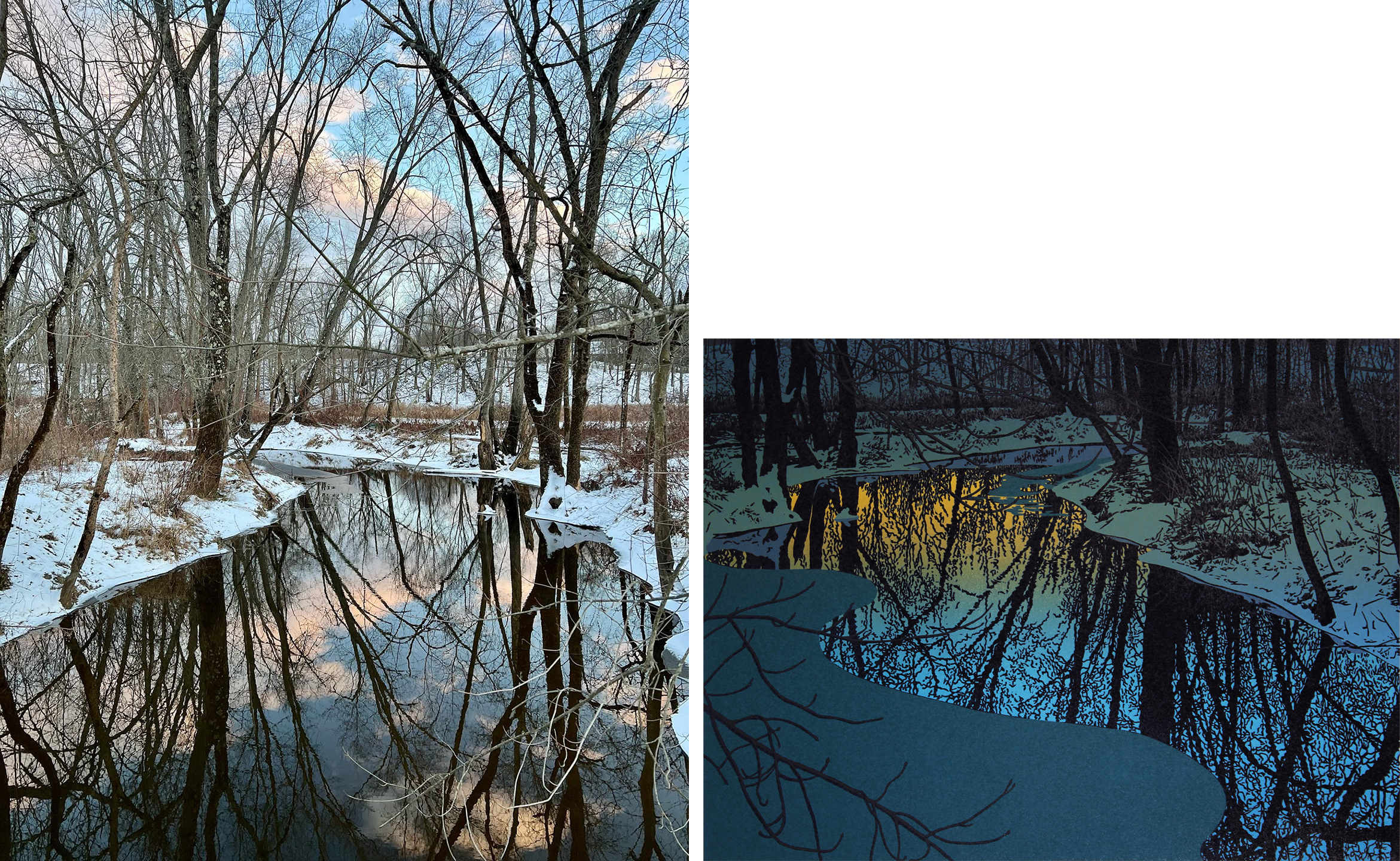
The original photo and finished print, "Dawn."
Although I often hear compliments about the detail in my prints, that is not really how I approach making them. I think of the carving this way: Carving defines structure. There are only three tools at my disposal - a knife, a U-shaped gouge and a V-shaped gouge. Using these three tools I find a stroke or a shape which will suggest something like a snowflake, a ripple on water or a blade of grass. Then I repeat that stroke without doing it the same way twice. That way I end up with a pattern which is not repetitious and stiff. Varying the frequency and density of the pattern provides flow and rhythm within the composition. I do take great care in my carving but it is still rather a blunt instrument compared to reality. I leave much out and our minds fill in the rest.
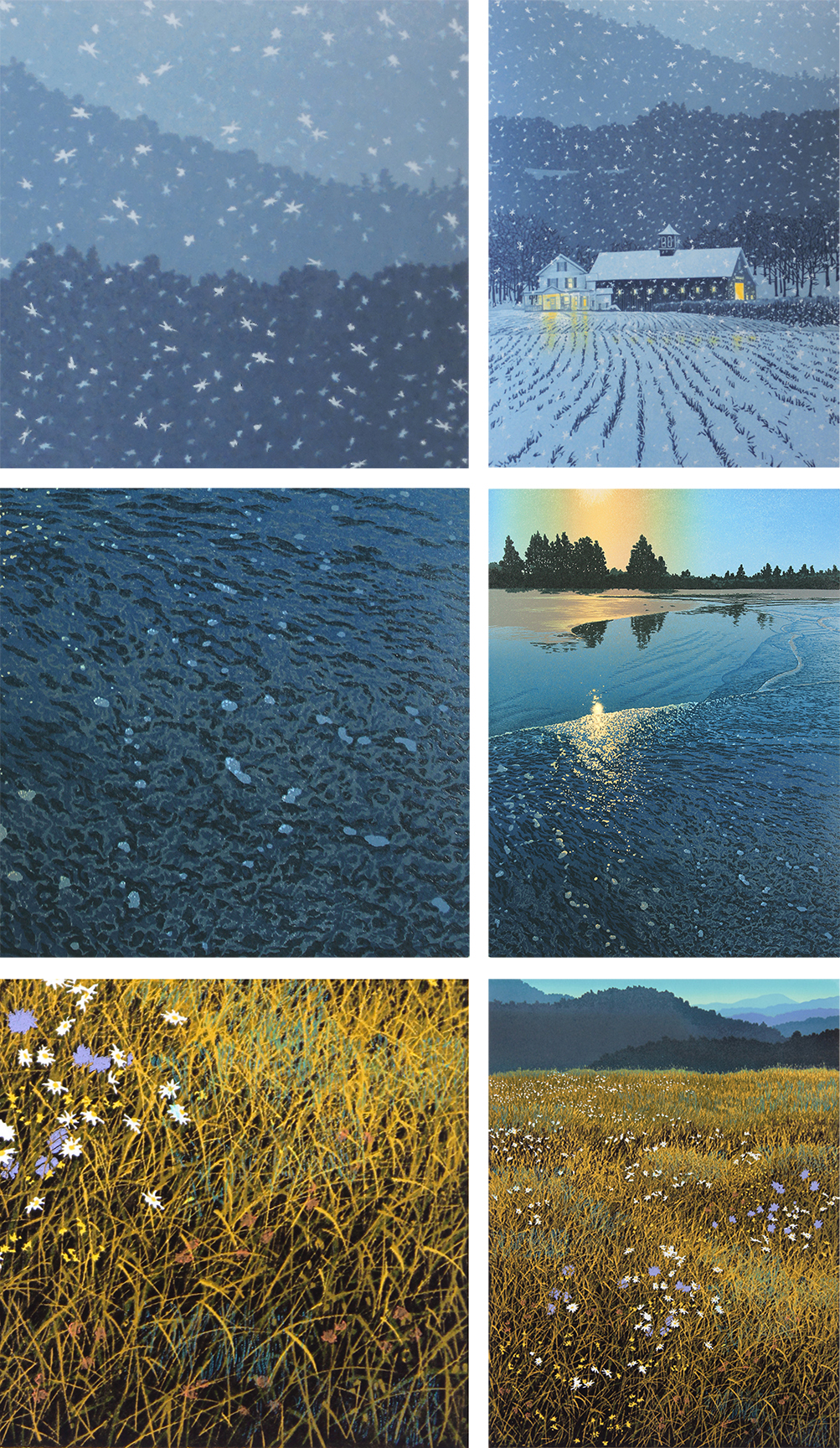
Patterns in three prints: "First Snow" (sold out), "Incoming Tide" and "Autumn Field" (sold out)
Carving can be a very complicated process. I mostly use one block and carve it multiple times. When looking at a half finished print and a half carved block, it can be more than a little difficult to figure out what is yet to be carved. What is supposed to look like imagery on the print looks like a jumble of abstract shapes on the block - and it is in mirror image.
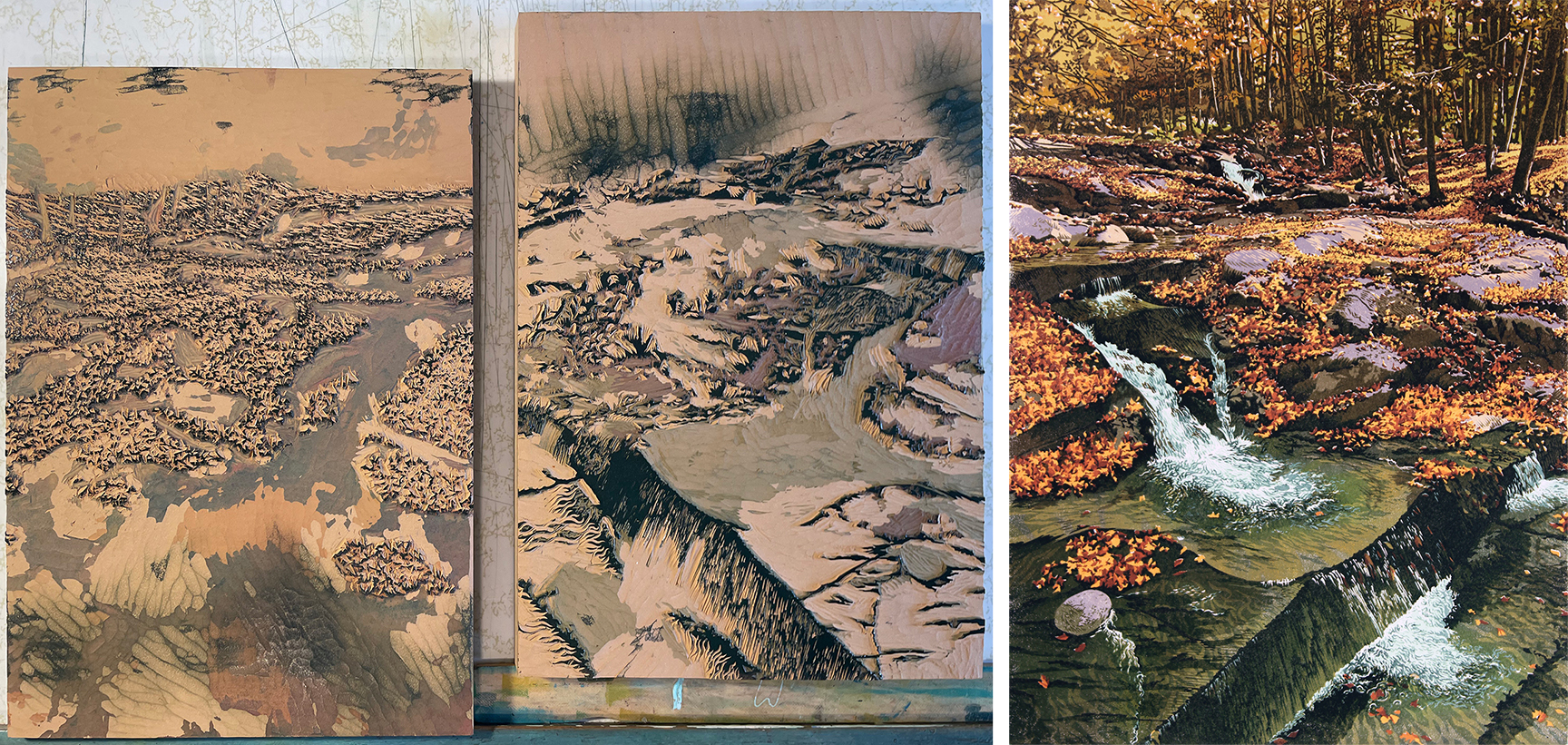
Two of the three blocks used to make "Autumn Cascade" and the finished print.
After more than fifteen years of carving, I find myself challenged and sometimes confused about what to carve and/or how to achieve a desired effect. This is not just occasionally. Reduction printing is a difficult set of mental puzzles which make me glad my pace is so slow. That way I have a lot of time to think about solutions to each particular step. Patience serves me well.
Carving requires many hundreds of decisions but aside from that, each impression of the print requires just a few decisions. And all of those decisions are irreversible in reduction printing. So I give each step a great deal of thought. The printing of more than 100 sheets of paper to make an edition is a slow and meditative process. One impression can take up to four days to print, depending on the number of colors I am applying to the block. This pace allows me time to consider and solve problems that are to come in the next impression.
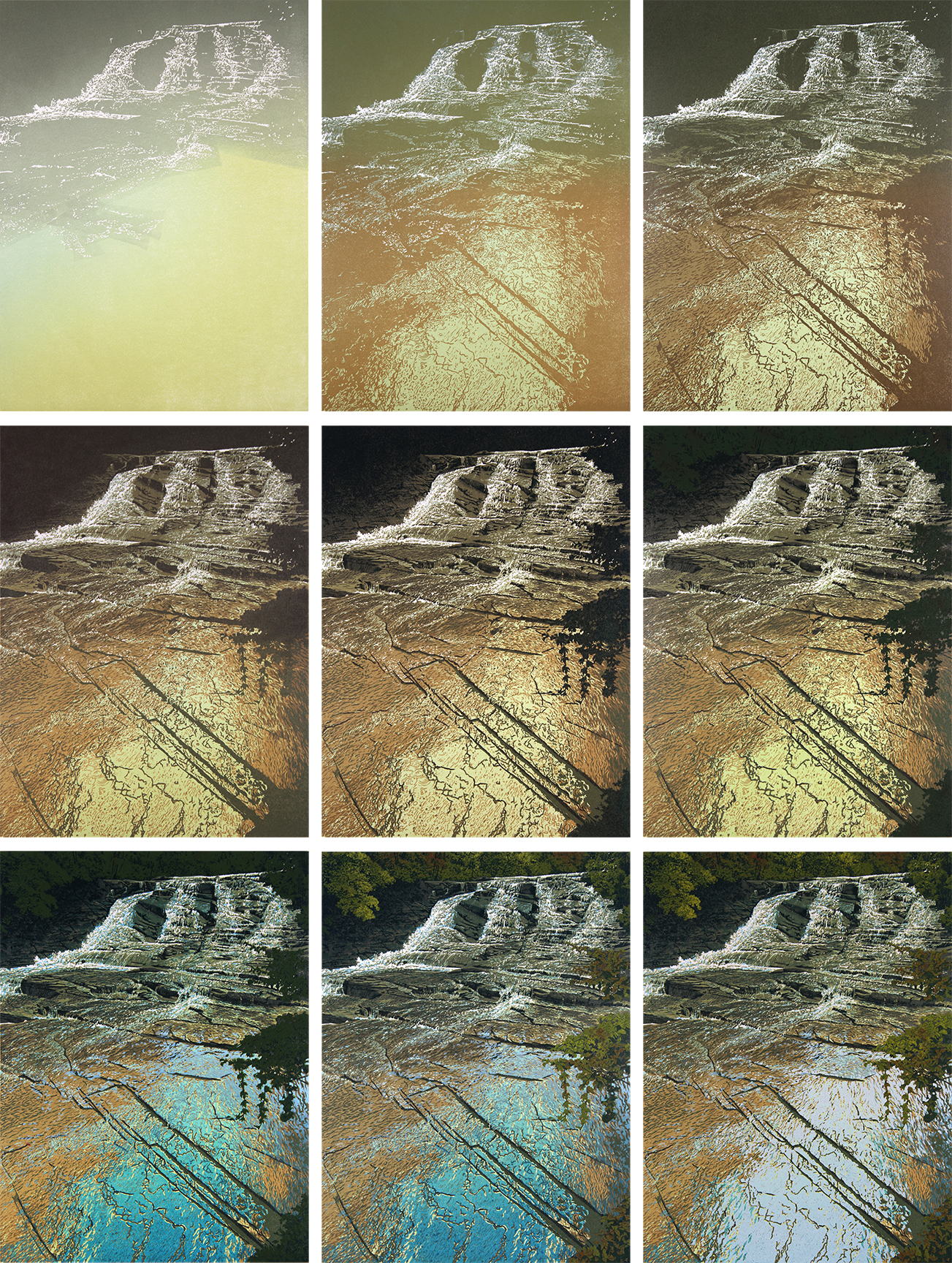
"Late Summer Falls" impressions one through nine
This slow, meditative process is usually difficult to dissect in retrospect. Sometimes I look back on a print to reference what I achieved previously and I'm unable to reconstruct what I did, even though I photograph each stage of the process. As a result, most of each print I do feels as if I'm doing this for the first time.
It is a fascinating learning process for me. Each print has its successes and its shortcomings. I try to direct most of my attention to the mistakes I make so that I know what I am not supposed to do in the next print.
I hope you enjoyed reading about my printmaking. If you have questions or would like to comment on what I've shown you, please write to me. I enjoy hearing from you!