Last Light Of The Day
Jun 03, 2024
HELLO AND WELCOME FRIENDS,
Carving clouds again?? Yep. That's me!
There’s a page on FB called The Cloud Appreciation Society and there are many wonderful photos of clouds which we all, inevitably respond to with awe and wonder. And so it is with me. My late wife used to chastise me while I was driving, accusing me of “mapping the sky.” I do that but I also try to stay on the road most of the time.
Since beginning printmaking in 2007 I have been exploring landscapes in their variety of moods and compositions. Clouds are often a part of it and always a challenge to address by carving blocks of linoleum or wood to make my prints. Clouds are so ephemeral and constantly changing in light and perpetually in motion. All of these things are amplified by the seemingly endless array of cloud types. And these qualities are very difficult to impart in relief printing.
How does one describe clouds by carving into a block of linoleum or wood? I can tell you that each time I give it a shot, it is different than the time before. How can there be a formula describing something which is constantly and rapidly changing?
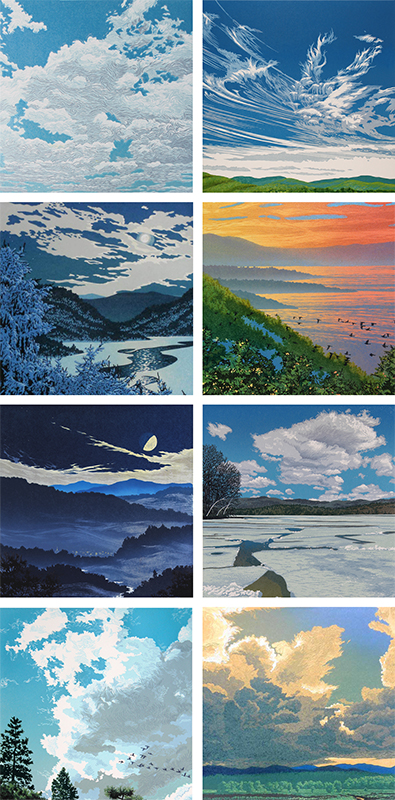
Above are some details of my past efforts to address clouds in woodcuts and linocuts (L to R, top to bottom - “Fair Skies”, “Cirrus Sky”, “Moonlight Lead”, “Winged Sunset”, “Mountain Melody”, “Ice Out”, “Migrant Sky”, “After The Storm”.)
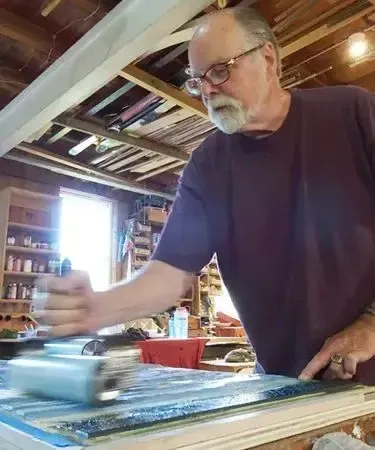
Every time I start a print with clouds it is a new challenge and this new print was indeed a challenge. I decided to address the sky and clouds with one block and then print the lower third (the ground) with another block. As I started in on the drawing for the clouds, keep in mind that I am not really drawing what the clouds will look like. I’m drawing instructions for myself for carving. I took nearly a week to do the drawing you see below. A great deal of thought went into these instructions to myself.
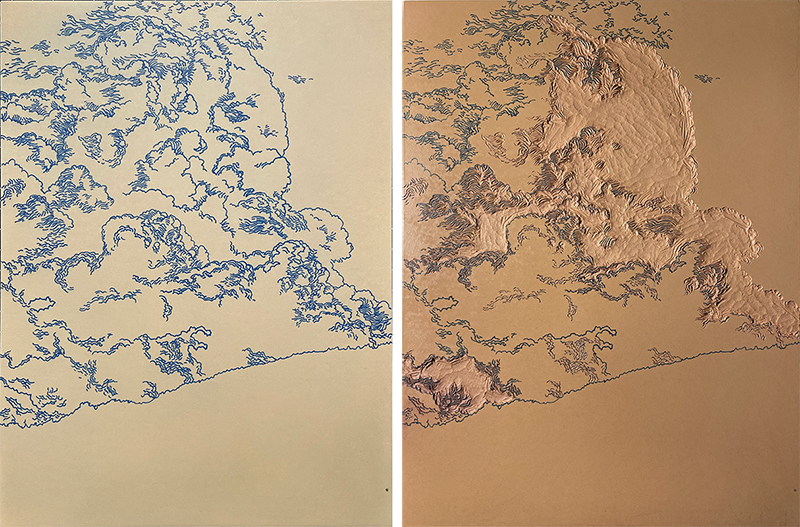
On the left, above, is the drawing on the block that took so long. On the right is the same block after two carvings, ready for the third impression. (The first impression was done without any carving, just the plain block inked.) And below are what the first four impressions were like.
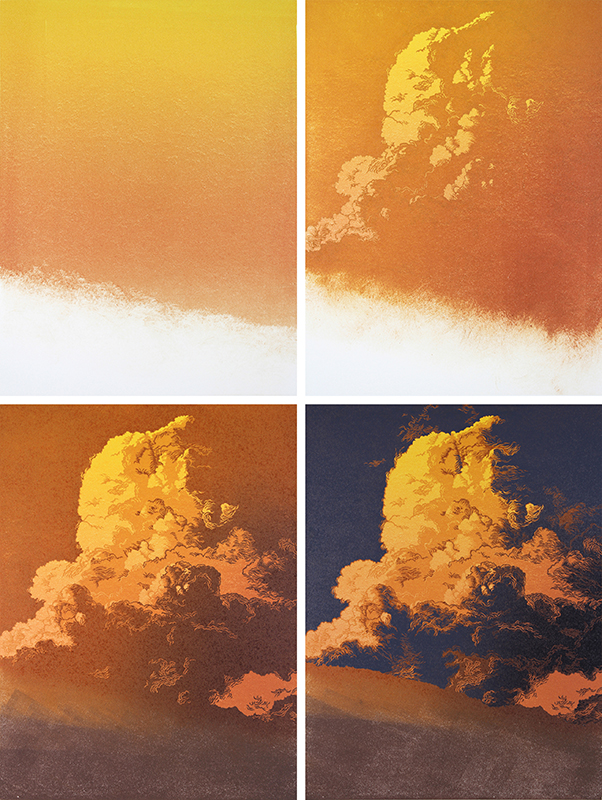
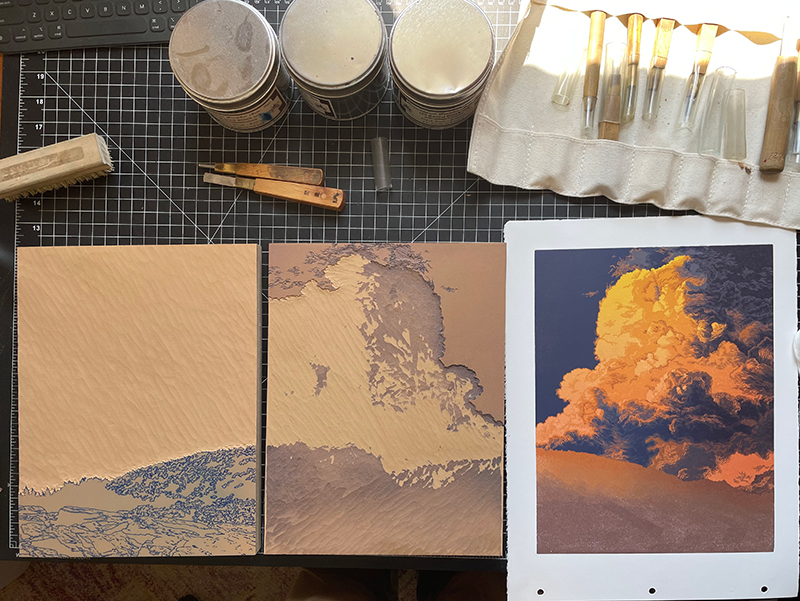
In the third impression (lower left) I introduced some dark under printing of color in preparation for the ground that will come with the second block. And here (below) is the second block before any printing along with the first block which has been almost completely carved away - all of it except for the sky behind the clouds. Those are my carving tools and a few pots of ink on my work desk.
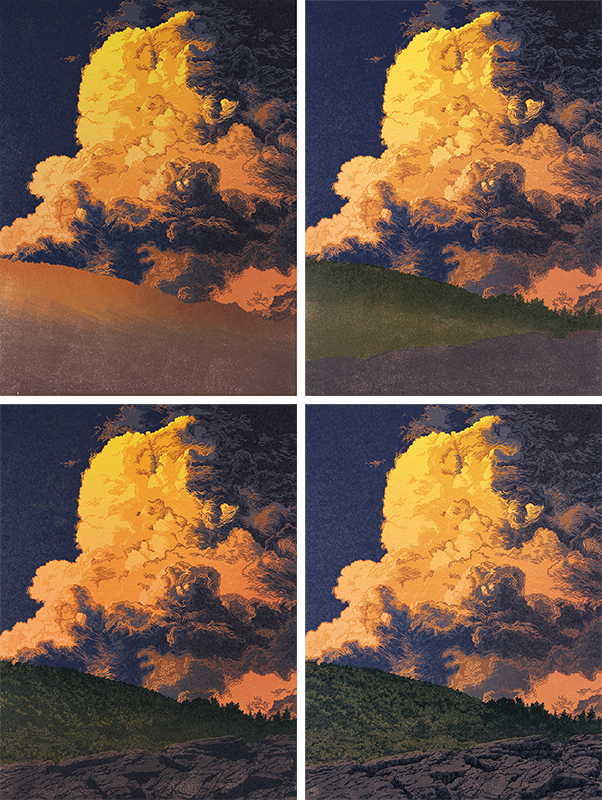
Below is the penultimate impression of the first block, followed by the three impressions which make up the lower part of the print from the second block.
After this I had just one more impression from the first block to go, I finished the print with the sky:
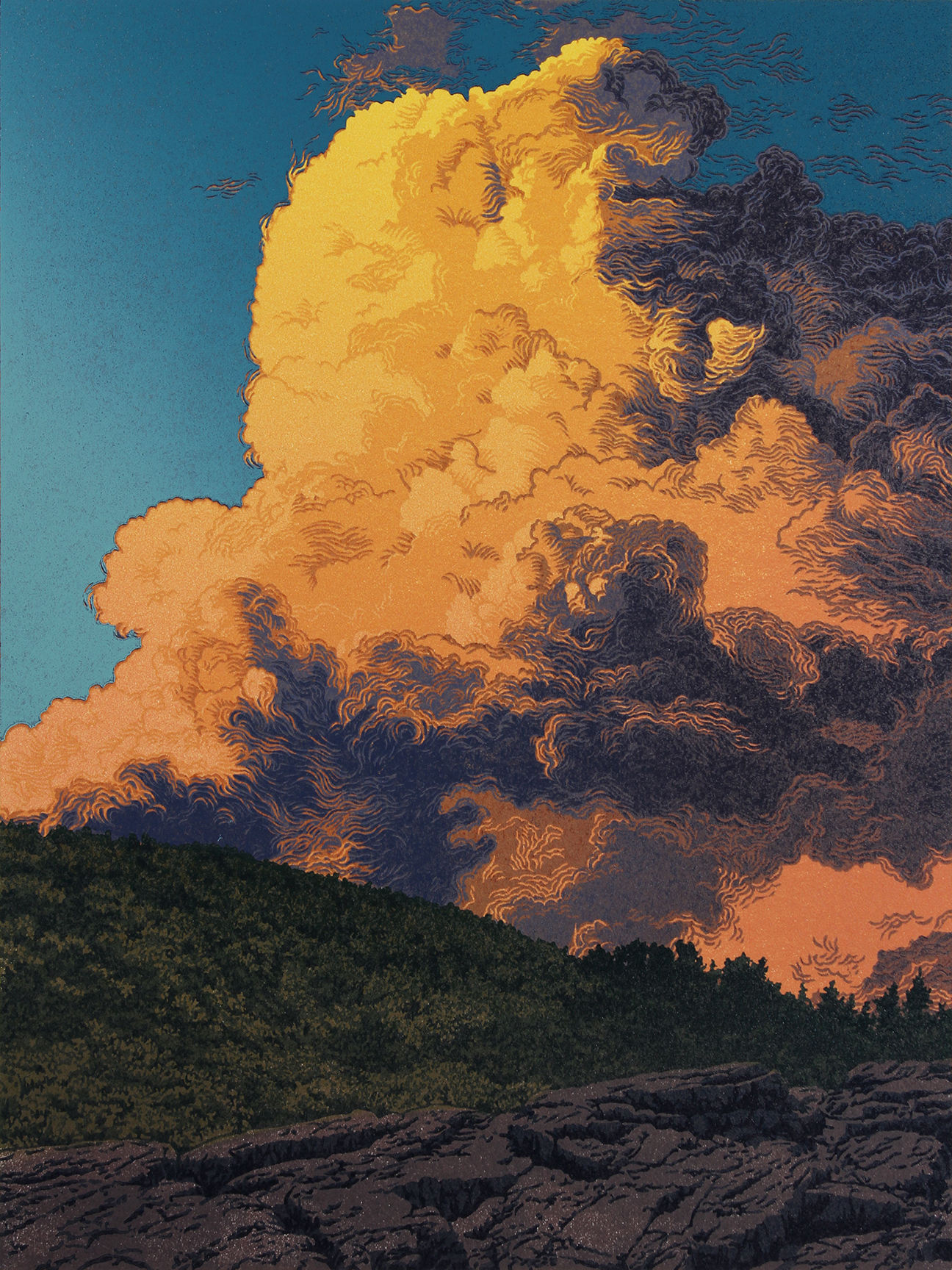
”Last Light” linocut print, 12” x 9” (31 x 23.5)
This is probably the most dramatic of my prints incorporating clouds. It is certainly the most complicated I’ve done to date. Still, I see areas where I believe I can do better. I’m certain this will not be the last relief print I do using clouds as my subject.
This project kept me busy for about two months. I do hope you enjoyed seeing this process. You would be surprised how much of what I've shown you I have forgotten. Seeing the process again in stages is almost as new to me as it is to you.
My prints have been featured in a number of recent national juried exhibitions and I’ve been privileged to receive special recognition for my work. At the moment there are two exhibitions in Connecticut which have my work. First is the Hudson Valley Art Association show in Old Lyme, CT (at the Lyme Art Association). Then in Torrington, CT is the Five Points Printmaking Exhibition at Five Points Arts Center. Stop by if you’re in the area. And take a look at the galleries which feature my work while you’re out this summer. Stop by and see my prints in person!
Of course, "Last Light" is available for purchase on this website. Feel free to write. I enjoy hearing from you!
Yours,
William H. Hays